
Taylor County Court Records After Arrest
After an arrest in Taylor County, the custody side starts at booking and the court side starts when a charging document is filed. The Taylor County Criminal District Attorney's Office represents the state in felony and misdemeanor cases arising within county jurisdiction. Its official page notes that misdemeanor offenses committed inside an incorporated city or town may be handled by the appropriate city attorney, so some low-level municipal matters may route away from the county prosecutor.
The formal court record may include a complaint, information, indictment, docket entries, bond orders, settings, pleas, dismissals, judgments, and later orders that restrict access. The Taylor County District and County Records hub and the District Clerk page both point users toward Search Court and Jail Records. For custody details, start with Taylor County jail inmate records. For booking photos, use the separate Taylor County jail mugshots resource.
The District Clerk is the registrar, recorder, and custodian for many court documents in causes of action. The clerk's work includes docketing, indexing, recording, collecting court costs and fines, and managing funds held in litigation. Those duties matter because a jail arrest may be visible first as a booking, but the court record becomes the durable case file once the charge is filed and indexed.
Find Taylor County Court Records After Arrest
Taylor County links court and jail searching through its official public-access system. The portal was confirmed in the research, but exact search-field labels were not available through terminal-readable HTML. Use the visible fields on the live portal and avoid assuming that a booking number, date range, or charge filter exists unless the portal shows it during the search session.
The Taylor County public-access portal is the first online route for criminal cases after a jail arrest. The same county ecosystem is used for jail and court record access, so a name search may need to be checked in more than one visible area. A case number from a bond paper, citation, notice, or jail record is usually a stronger search value than a common name.
- Open the county records hub or the public-access portal linked as Search Court and Jail Records.
- Search by defendant name, and use a case number if a jail record or court notice provides one.
- Open each matching criminal case and compare the filed charge list with the jail booking charge.
- Check the court, case number, charge level, status, next setting, bond entry, and disposition if those fields are displayed.
- For older, sealed, or unavailable files, contact the clerk that holds the case record rather than relying on a third-party index.
The Texas DPS Crime Records Division is a separate statewide criminal-history route. DPS records are not a substitute for a Taylor County case file, and Texas Government Code §411.083 limits criminal-history-record information except as authorized by law.
The county records hub screenshot is a useful reference because it shows the official starting point for both jail and court access: Taylor County District and County Records.
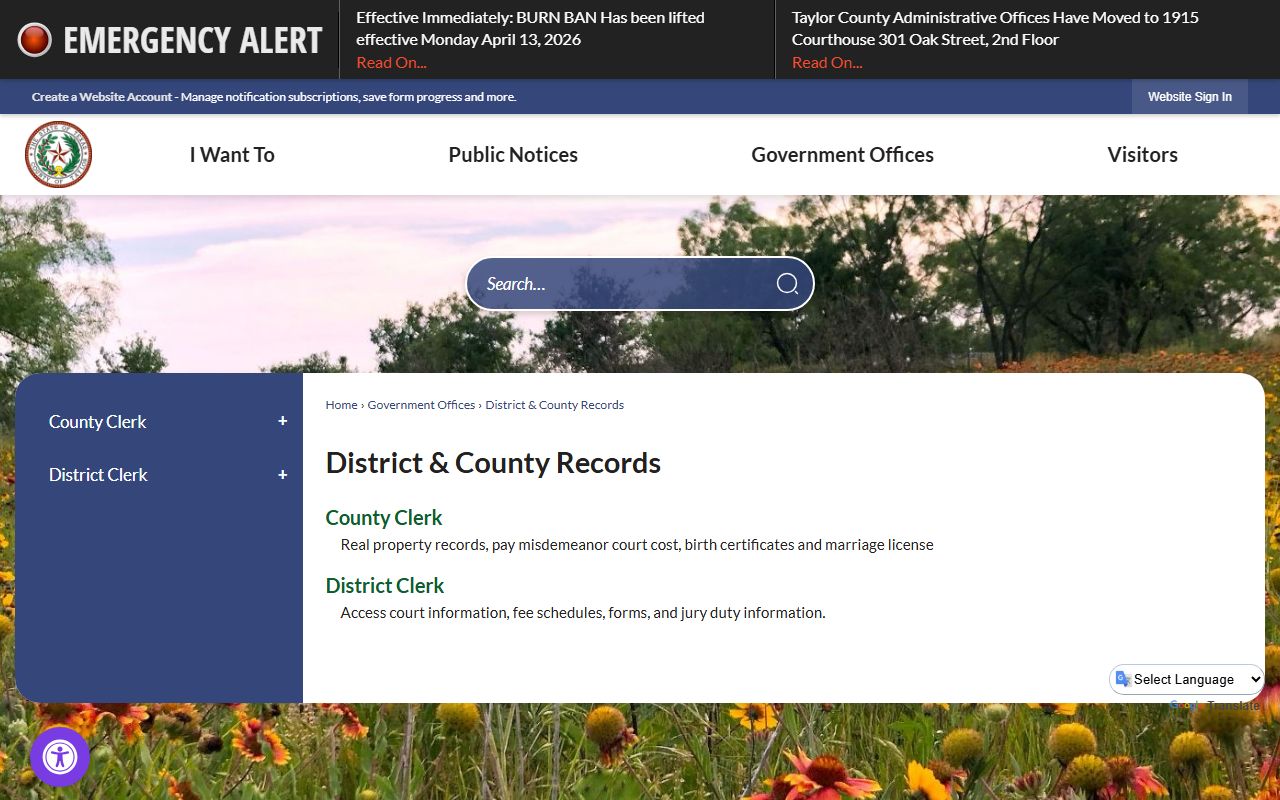
Use that hub when a direct portal link fails, times out, or changes, because the county page is the source most likely to carry a current public-access link.
Taylor County Arrest Charge Documents
A jail booking charge is not always the same as the formal charge filed in court. Booking reflects the arresting agency's custody information. The later court charge depends on the prosecutor's filing decision, a grand-jury action when required, or another charging paper accepted by the court. Taylor County's DA office handles state criminal cases in county jurisdiction, while the District Clerk and other clerks maintain court records once a case exists.
| Document | What It Means | Taylor County Route |
|---|---|---|
| Complaint | An early sworn accusation or charging basis that may appear before later charging action. | Search court records and verify with the clerk or prosecutor if the case is pending. |
| Information | A prosecutor-filed charging document often used in misdemeanor cases and some felony procedure contexts. | The Criminal District Attorney prosecutes felony and misdemeanor cases in Taylor County jurisdiction. |
| Indictment | A grand-jury charging document used for felony prosecution. | District court records route through District Clerk custody and public access when not restricted. |
The Taylor County Criminal District Attorney page identifies James Hicks as the Criminal District Attorney and lists divisions for felony, misdemeanor, juvenile, victim assistance, appellate, civil, and other functions. Those divisions help explain why court records after a jail arrest can split by charge level, victim-service needs, or later appellate activity.
The DA source page is directly relevant to charging decisions after arrest: Taylor County Criminal District Attorney.
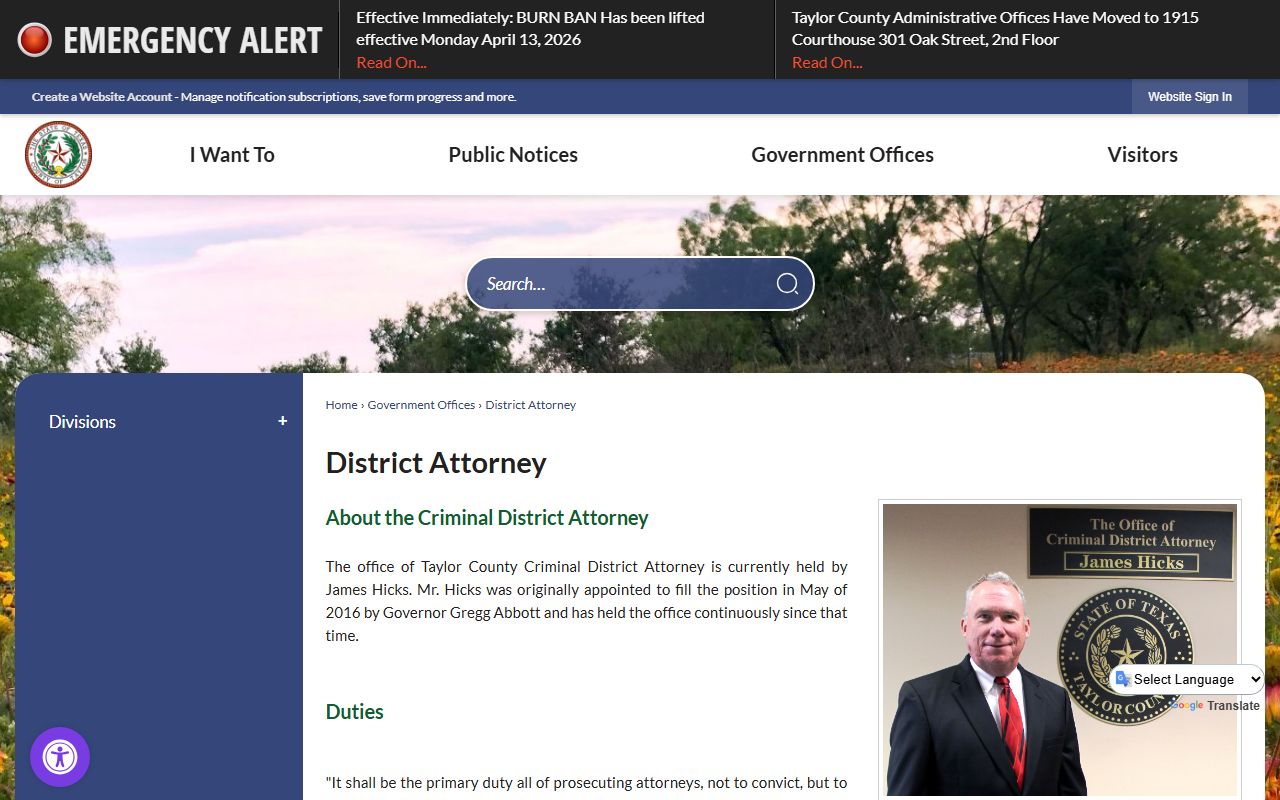
For a pending case, the DA's office is not a substitute for the clerk's public record, but it is the local source for understanding who prosecutes the charge.
Taylor County Charge Status
Charge status can change after a jail arrest. A case may start with one allegation, then be amended, reduced, enhanced, dismissed, or resolved by plea or trial. That is why a roster entry should not be treated as the final legal outcome. The court docket, clerk record, and disposition fields carry the later case history when they are public.
| Status | What It Means | Access Route |
|---|---|---|
| Pending | The charge has not reached final disposition. | Check the public-access portal and clerk entries for settings or orders. |
| Amended or reduced | The filed charge changed after review, plea negotiation, indictment, or court action. | Compare the booking charge with the court charge list and docket text. |
| Dismissed | The court record shows the charge ended without a conviction on that count. | Verify the dismissal order or disposition entry with the clerk. |
| No-bill or not filed | A grand jury or prosecutor did not proceed on the charge in the expected form. | Ask the clerk or prosecutor's office which record, if any, is publicly available. |
| Convicted | A plea, verdict, or judgment created a conviction record. | Review the judgment and sentence fields in the case record. |
Access routing: Use the court portal for filed charges, the jail phone for present custody, TCSO records for sheriff-held criminal records, and DPS only for authorized statewide criminal-history access.
Taylor County Bond After Arrest
Texas Code of Criminal Procedure Article 15.17 supplies the statewide first-appearance and magistrate-warning framework after arrest. Texas Code of Criminal Procedure Chapter 17 governs bail. Taylor County's official jail pages did not publish a local bond-payment page or accepted bond-payment methods, so bond status should be checked through the public-access record, the court, the jail at (325) 691-7423, or the Sheriff's Office at (325) 674-1300 for routing.
| Bond Type | How It Works | Taylor County Note |
|---|---|---|
| Cash bond | The full amount is posted as allowed by the court or jail system. | Local accepted payment methods were not published in the located official jail pages. |
| Surety bond | A licensed bail agent posts bond for a commercial fee. | Texas permits commercial bail, but no individual bondsman list should be treated as official here. |
| Personal or PR bond | The court releases the person on a promise to appear, often with conditions. | Release depends on the magistrate or court order. |
| No-bond hold | The person cannot be released on ordinary bond for that hold. | Common causes include parole, bench warrant, federal, ICE, or another-county holds. |
A person may remain in the Taylor County Adult Detention Center even when a local charge has bond if another agency has placed a hold. The court record may show the Taylor County case status, while the jail record or jail staff may be needed to confirm why release has not occurred.
Taylor County Warrants After Arrest
No official Taylor County Sheriff's active warrant database with an inspectable public list was located in the research. A warrant may still appear through a court case, a bench-warrant entry, a failure-to-appear event, or the sheriff records process. Municipal bench warrants may remain with the issuing city court or police system rather than the county website.
For warrant-related record checks, use the Taylor County public-access portal for court cases and the Sheriff's Records page for written TCSO criminal-record requests. The Sheriff's Records page says requests must be in writing and may be submitted in person, by fax, or by U.S. Mail with a copy of the requester's photo driver's license. Anyone who believes an active warrant exists should contact an attorney or the issuing court before appearing in person.
Note: A live warrant question is not the same as a past court record, and phone staff may route rather than resolve the issue.
Taylor County Charges vs Convictions
An arrest and charge are accusations, not proof of guilt. A conviction exists only after a plea, verdict, or judgment creates that result in court. Taylor County jail records may help identify why a person was booked, but the court record is the source for what was filed, what changed, and how the case ended.
| Point | Charge | Conviction |
|---|---|---|
| Stage | Accusation after arrest or filing. | Final outcome by plea, verdict, or judgment. |
| Proof level | Based on probable cause or a charging decision. | Requires proof beyond a reasonable doubt or a valid guilty plea. |
| Where seen | Jail record, complaint, information, indictment, or docket. | Judgment, disposition entry, sentence, or state offender record after transfer. |
| Can change | May be amended, reduced, enhanced, dismissed, or not filed. | May be appealed, set aside, sealed, or expunged only through lawful process. |
Taylor County Sealed and Expunged Records
Texas expunction and nondisclosure are different. Expunction under Texas Code of Criminal Procedure Chapter 55A can remove eligible criminal records by court order. Nondisclosure limits public access to eligible records but does not mean the same thing as expunction. The research found Taylor County navigation for nondisclosure through the County Clerk area and an Expunctions page under District Clerk navigation, so records-clearing issues should be handled through the court process, not through a jail roster request alone.
| Issue | Nondisclosure or Sealing | Expunction |
|---|---|---|
| Public visibility | Limits public access when a court order applies. | Can remove eligible records from public access and treat them as cleared under the statute. |
| Record existence | The record may still exist for authorized access. | Eligible records may be destroyed or returned as ordered by the court. |
| Common trigger | Eligible deferred adjudication or other qualifying outcome. | Eligible dismissal, acquittal, pardon, or other qualifying Chapter 55A ground. |
| Practical step | Use the court record and clerk route to confirm the order. | File or verify the court order before expecting public systems to change. |
Important: A dismissed charge can remain visible until the correct court order restricts access and the record custodians process that order.
Restricted Taylor County Court Records
Texas public-information law supports access to public records, but it does not make every criminal justice record open online. Texas Government Code §552.021 makes public information available during normal business hours unless an exception applies. Texas Code of Criminal Procedure §66.252 identifies public information in computerized criminal-history systems, while Texas Government Code §411.083 protects DPS criminal-history-record information except as authorized.
Restricted records can include juvenile matters, sealed or expunged records, medical and mental-health information, protected criminal-history data, internal classification notes, and records tied to ongoing law-enforcement needs. The safest route is to match the question to the custodian: jail custody to the Taylor County Adult Detention Center, sheriff-held criminal records to TCSO Records, filed court cases to the relevant clerk, statewide conviction history to DPS, sentenced state custody to TDCJ, and federal or immigration custody to the federal system.
The District Clerk source is useful for understanding the court-record custodian role: Taylor County District Clerk.
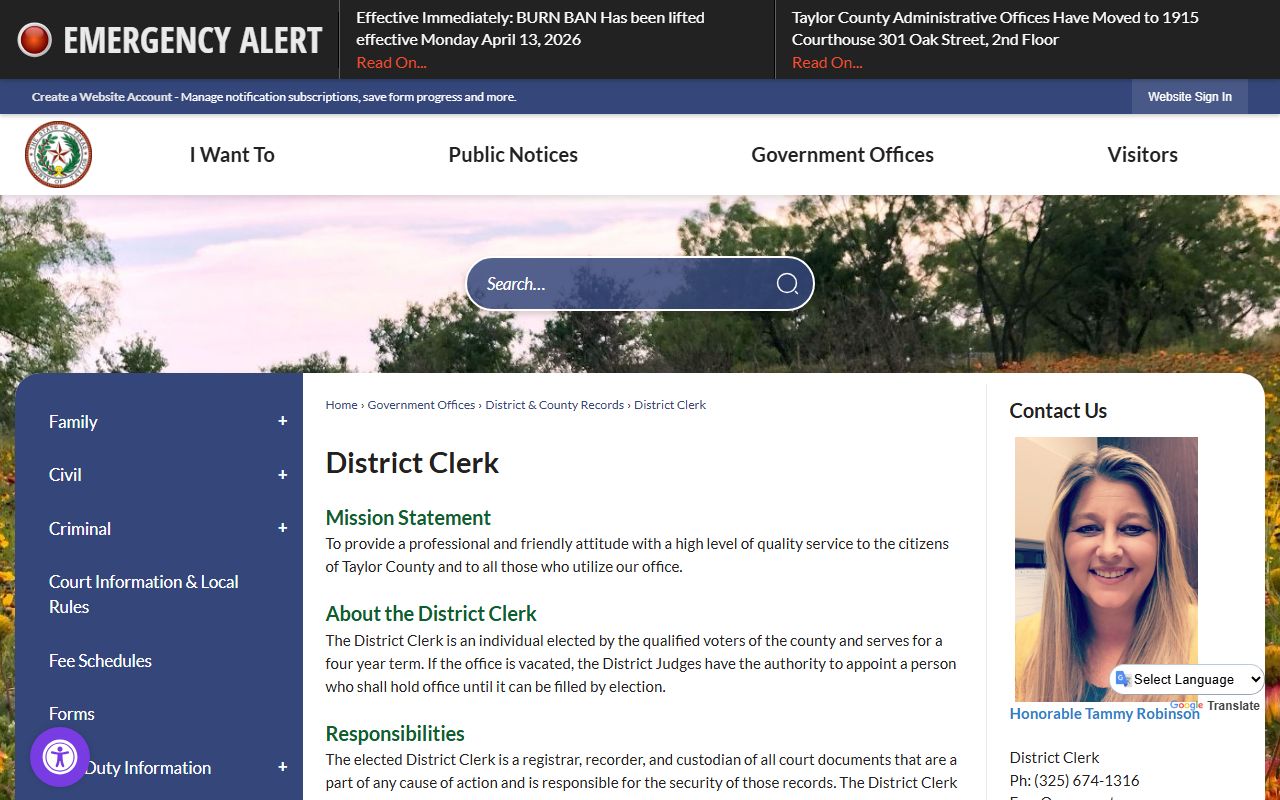
That clerk role is central when a person needs the filed case record rather than a jail roster entry or a broad criminal-history search.